 FAKE RONJAN!!
Competitive Balance in the NBA
The first post on this site was an overview of competitive balance in the NFL. The basic analysis was to predict next season's standings using this season's standings. The more accurate the prediction, the less competitive balance the league has.
I wanted to run the same analysis on the NBA. Intuitively, most people would assume that the NBA has less competitive balance because we tend to see the same teams, players, and rivalries every year. Does this hold up?
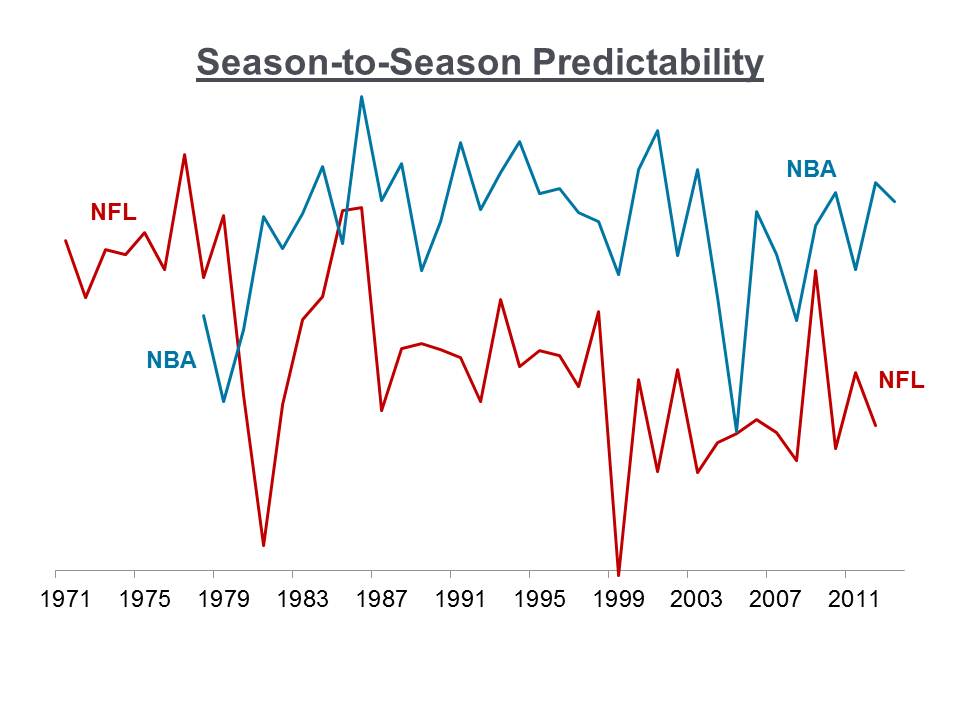
In a word -- yes. The NBA is more predictable than the NFL. It's as simple as that. This could be good or bad depending on your perspective. (Given my love of rematches, my love of rooting against dynasties, and my hatred of weak title defenses, I love it!)
Some notes on the chart above:
- The ABA-NBA merger was in 1976 and it took a few seasons for the league to hit equilibrium. Adding young Bird and Magic to the mix probably made things a bit more volatile at first.
- The mid-1980s are super predictable. That entire decade only 5 teams made the NBA Finals. Yes, you read that correctly. (Lakers, Rockets, Celtics, Sixers, and Pistons.)
- There is no dip in 1994 when Jordan retires for the first time. This is because the Bulls -- in the regular season -- only barely fell from 57 wins in 1993 to 55 in 1994.
- There is a larger dip in 1999 when Jordan retires for the second time, but the NFL had its wackiest season ever to make the NBA look reasonable by comparison.
- 2005 was the least predictable season in NBA history. This is all about the Kobe-Shaq breakup, with Shaq joining the Heat and the Lakers missing the playoffs as a result.
- 2008 saw the rise of the Celtics super-team, while 2011 saw LeBron and Bosh take their talents to South Beach, so that's why we see small blips in those seasons.
Obvious analysis is obvious?
-rj