 FAKE RONJAN!!
Competitive Balance in the NFL
The NFL is uniquely positioned within American sports when it comes to competitive balance
We savor that every team has a chance to win it before the opening kickoff: the 1981 49ers, 1999 Rams, and 2001 Patriots all came out of nowhere to win the Super Bowl a year after coming nowhere near the playoffs.
Yet the sport is also celebrated for its dynastic powerhouses: the 60s Packers, 70s Steelers, 80s 49ers, 90s Cowboys, and 00s Patriots each won at least 3 championships in their respective decade of dominance.
The league instituted a salary cap in 1994 that was the first of its kind in American sports -- a hard cap that made it tough for great teams to keep their talent together. This arguably accelerated the decline of the 49ers and Cowboys after they met for their 3rd straight NFC Championship game that season.
Yet, as teams adjusted to life under the cap, the Patriots, Colts, and Steelers combined to represent the AFC in an absurd 9 consecutive Super Bowls (2003 through 2011), making it clear that dominant teams could still exist and stay together.
So I was curious -- do we actually have more competitive balance today in the salary cap era, or did it just seem that way because of the shift in power that we saw in the late 90s?
Analytical approach
I approached this question by asking a very simple question for every season since the AFL-NFL merger (1970): If you wanted to predict next year's standings by using this year's standings, how accurate would you be?
The better your prediction would be, the less turnover there is season to season, so the less competitive balance the league would appear to have.
(For anyone who's interested, the specific calculation was looking at correlation across teams of their winning percentages between year n-1 and year n.)
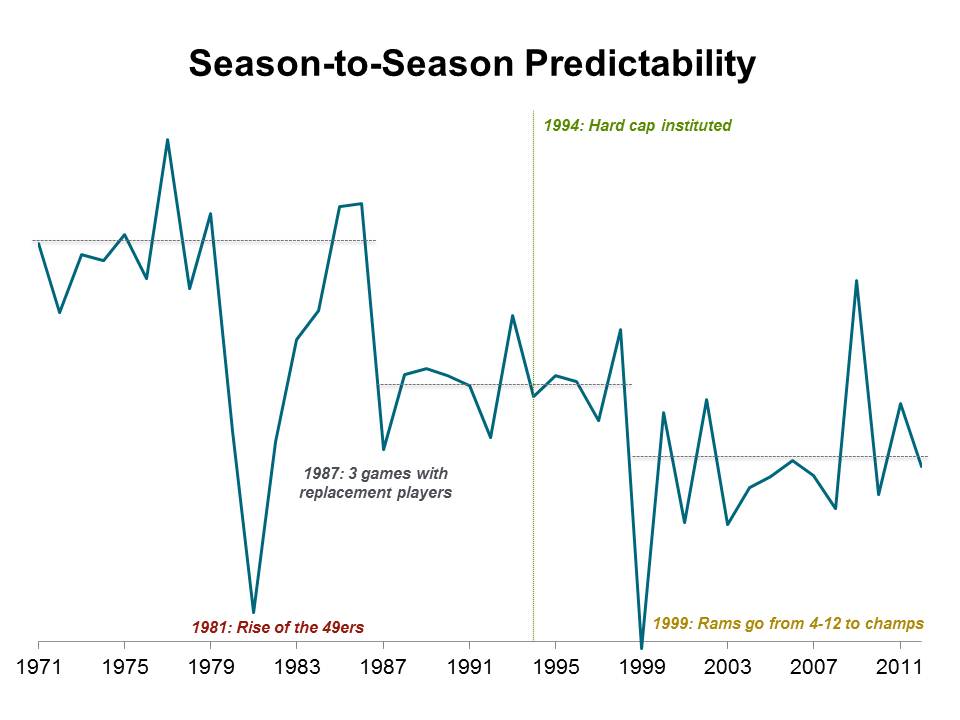
Below is a plot of what these season-to-season predictions look like over time. The higher the line is for a given year, the more easily you could predict that season's final standings just by looking at the previous season.
Some thoughts on the results
It appears that we can confidently say that we have more competitive balance now than we used to in the NFL!
The 1970s are very stable. We have a lot of teams at the top that stay on top, like the Steelers, Dolphins, Cowboys, and Vikings (at least before they reach the Super Bowl).
1981 is a transition season as the 49ers become the new torchbearers after going just 6-10 in 1980. However, we begin to see stability return as they and the Redskins become the new bullies on the block.
Interestingly, the 1987 strike appears to be a catalyst for unpredictability over the following ten years. The late 80s through late 90s were a fascinating era marked by 10 Super Bowl wins by just four NFC franchises (Giants, Redskins, 49ers, and Cowboys) and 13 straight for the NFC overall. However, due to turnover in the AFC, the league in general becomes more unpredictable.
1999 is the next bell-weather year. Was it the impact of the salary cap? The 49ers were finally broken, finishing 4-12 in failing to hit 10 wins for the first time since 1982 (when they went 3-6). Was it the fact that several legendary quarterbacks were winding down their careers? Kelly, Elway, Marino, Young, and Aikman would all retire by the end of 2000.
Who knows. The bottom line is that in 1999, 2000, and 2001, each season a non-playoff team would rise to win the Super Bowl with a quarterback who wasn't the starter when training camp opened. Wacky! Parity!
After the shock of those seasons, the league has settled into a level of equilibrium, far below the traditional levels of predictability. It appears that we have retained some the most interesting elements that dynasties bring to sports while also allowing every fanbase to believe in their team.
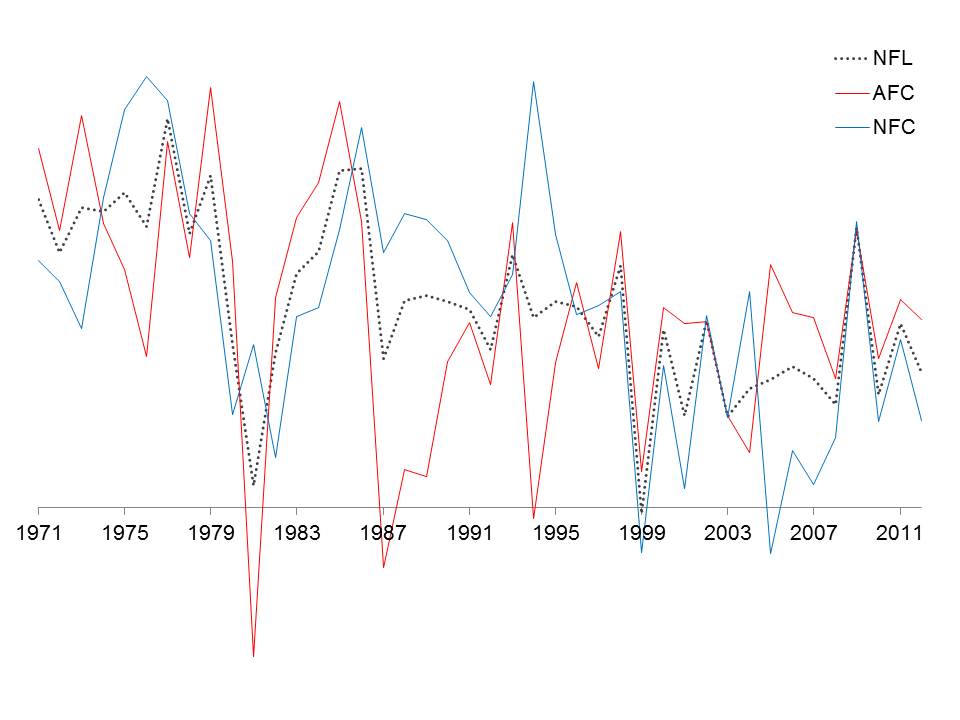
If you're interested in the AFC vs. NFC version of the above chart, it is below. It's one heck of an eye chart, so enjoy!
Thanks for reading!
-rj