 FAKE RONJAN!!
Competitive Balance in (the?) MLB
If you've been reading this site since our first post in March, you should be familiar with our previous posts on the topic of competitive balance. If you need a refresher, we looked at both the NFL and the NBA and examined how consistent year-to-year performance was by looking at how well you could predict next year's standings using this year's standings.
Well, we have now done the same analysis for baseball.
Baseball is an interesting one -- it's the sport with the longest season, so "fluky" results become less likely. But with no real salary cap, it also has a reputation for having the same teams dominate every year. So is baseball the most predictable of the "big three" domestic sports?
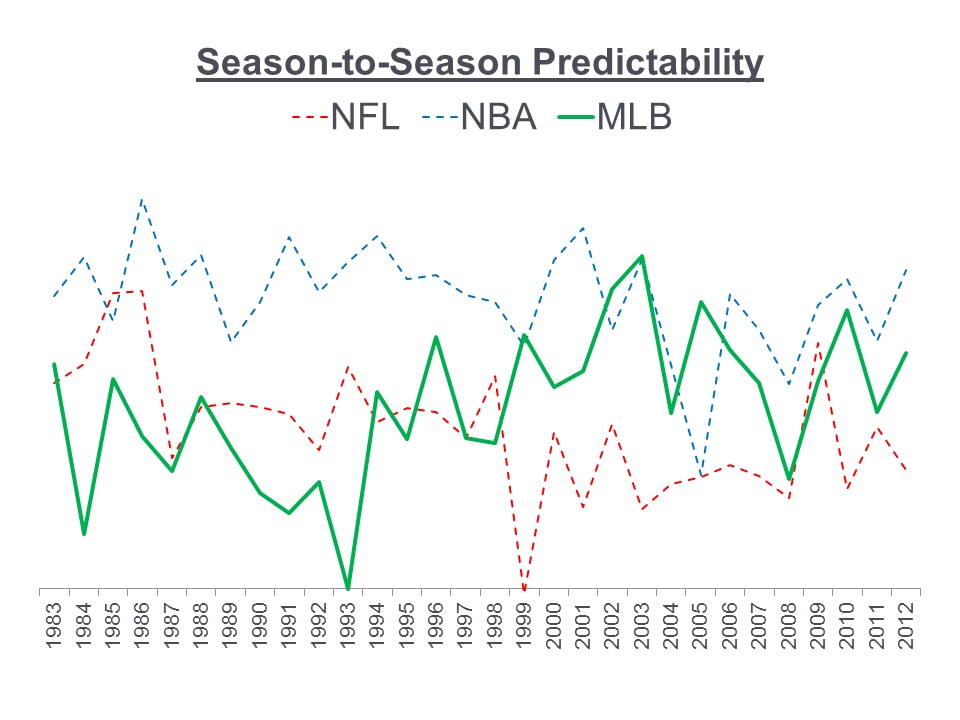
The answer: it has changed a lot over the past 30 years! Some notes:
- Before the strike in 1994, baseball was the least predictable of the three biggies. This shocks me -- with a 162 game season, you'd think there'd be far more season-to-season consistency. Then again, I do recall growing up with the Cincinnati Reds rotating good and bad seasons every other year.
- 1993 is the season where Bonds was traded from the Pirates to the Giants. To give you an indication of how big of a trade that was, if you flip those teams' 1993 records, that season's predictability goes up to the same level as the previous three years. Just one trade dropped the correlation to 0.00!
- That 1993 baseball season was the 2nd-least predictable season across the three sports in the past 30 years (with the 1999 NFL being #1 on that list).
- Ever since that strike, baseball has settled in as the 2nd most predictable sport. For all of the criticism of the Yankees buying everything, baseball has more turnover at the top than the NBA.
I don't necessarily have a strong perspective on what drove baseball becoming more predictable in the era of free agency and big money while the NFL simultaneously became less predictable (and the NBA stayed the same). Perhaps the devil really is in the details, and the mechanics of a hard cap, luxury tax, and revenue sharing have very real implications?
Anyone have any theories?
-rj