 FAKE RONJAN!!
NFL Power Rankings: introducing OLANDIS
If there's one thing I love doing, it's power rankings. And if there's one widespread aspect of sports analysis that is truly useless, it's power rankings. Talk about a match made in heaven! And so we kick off a weekly segment where we use a power ranking algorithm to rank the 32 NFL teams.
This week, we'll introduce the model, named OLANDIS. (If Baseball Prospectus can name their projection system PECOTA and the Football Outsiders can name theirs KUBIAK, this is fair game, right?!)
The OLANDIS system is a modified version of my Excel-based power rankings that I've used in the past, most notably for our semi-annual office Tetris tournaments. Here are some of the principles and defining factors for this model:
- Only two things matter: who you played and the scoring margin. You'll get credit for beating a bad team by a lot or beating a good team by a little, but you'll get more credit for beating a good team by a lot. This is the basic principle of the "Simple Rating System" and any optimization-based rankings system.
- The model outputs a number for each team which we'll call their "Rating". The difference between two ratings is the expected margin of victory in points for a game between those teams (add 3 to the home team). So the numbers that the model spits out actually have meaning in relation to each other.
- The model is looking to most accurately predict what has already happened. That is to say, there is no predictive element here. Some may classify this type of ranking as "predictive" because it incorporates strength of schedule and margin of victory, but the model has been optimized to look backwards, not forwards. This is the opposite of something like DVOA, which is focused on predicting the future and thus has actual value!
- As the season progresses, earlier weeks will be down-weighted in comparison to later weeks. The cutoffs and levels that I decided to use are completely arbitrary. Weeks 1-4 have a baseline weight, weeks 5-8 are weighted up by 25% in their impact, weeks 9-16 are weighted up by 50%, and week 17 is back down to baseline weight to account for teams resting their starters. All playoff games are double-weighted. We'll see what this means for the results!
At this point, I ran the first three NFL weeks through OLANDIS. Here's what the top 5 looked like:
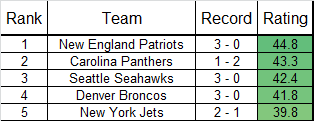
Hmmmm. It's never a good sign when a team loses at home to a team that's below it in the rankings this early in the season. Sure, it's possible that the 1-2 Panthers are better than the 3-0 Seahawks, but the only reason this model places them higher is because of the unrelated 38-0 pummeling that the Panthers just handed the Giants. That's why I added one last principle to the list:
- If two teams are close in the rankings, boost the one that won the head-to-head matchup. Prefer optimizations that minimize the number of retrodicted upsets. In other words -- if the model says that the Panthers are better than the Seahawks based on a points optimization, it better have a lot of evidence to back this up. Otherwise, we're better off swapping them in the rankings.
Below are the full rankings with this new adjustment. And just a reminder -- this is just a formula; OLANDIS does not watch football!
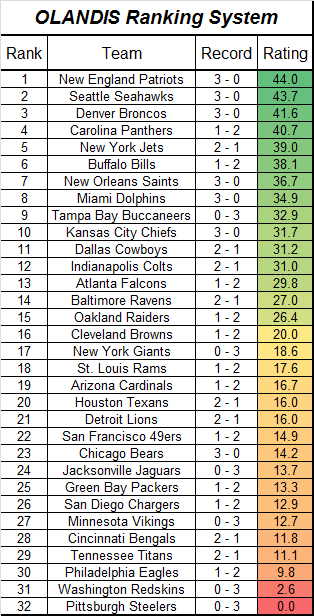
OLANDIS, you want to start some controversy early, eh?! My thoughts:
- OLANDIS really likes the 1-2 Panthers and Bills as well as the 0-3 Bucs. This is all because OLANDIS thinks that a close loss to a good team is a statement in itself. So when the Panthers drop a close one at home against the Seahawks or a close one on the road against the Bills (who themselves have close losses to highly ranked teams), they're not overly penalized. That said, I don't personally buy that these teams are that good, though, and I predict that all three drop out of the top 10 soon.
- There is a huge disparity between teams at the top and those at the bottom. In fact, OLANDIS favors the Patriots by 44 points over the Steelers! That will come down significantly as matchups get more diversified and we start to see upsets take shape.
- Speaking of upsets, OLANDIS was able to perfectly rank-order the 32 teams so that there were no upsets in the first three weeks of the season (once you account for 3 points for home field advantage). I'm guessing that this doesn't last long.
- Bengals fans must hate OLANDIS already. After beating the powerful (or so we thought) Packers, they're below the Jaguars, who appear to have the potential to be one of the worst teams in league history? Blasphemy! OLANDIS counters by asserting that the Bengals' two wins are over teams that are a combined 1-5, with the Packers' lone victory coming against the winless Redskins. As the Steelers, Packers, and Redskins improve, they'll lift the Bengals in the rankings.
- I was surprised to see the Giants so high. But all of their losses have been to teams that OLANDIS likes. Sorry Giants fans, but you'll have to lose worse next time around.
We'll update these rankings every Tuesday to see if OLANDIS comes to its senses!
-rj
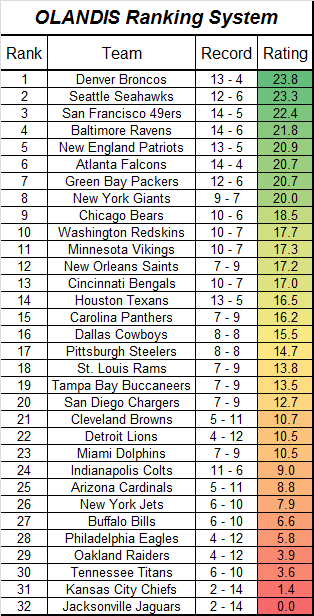
PS: See below for the 2012 season-end power rankings using this same formula.