 FAKE RONJAN!!
Useless Conversations: Quitting the NFL
As most readers know, this site's founder cut the NFL out of his life 3 years ago. I wondered why'd he done it, and how the experience has gone. Below is a transcript of our conversation.
Chris: So almost four years ago, you started a site, Useless Sports Analysis, where the two of us (plus others) covered everything from college football and basketball, to baseball, the NFL and the NBA. In 2015 you re-branded the site Useless Analysis, which I think was in part because you wanted cover a greater breadth of your interests... but I also feel that it reflected sports' diminished importance in your life by then. Is that a fair read of the change?
RJ: Wow. 4 years. That is crazy!
Your read is dead on. For most of my life I was addicted to sports and analysis of sports statistics. It was a confluence of events - such as cutting the cable cord in 2011, quitting the NFL in 2013, and having a child in 2014 - that led to a sharp decrease in the passion I have for watching sports.
The most unexpected thing? I barely watch the NBA at all, despite continuing to adore the league. It’s really hard to explain how I am a hardcore NBA fan who watched all of 7 games last season.
Chris: Your NBA fall off is definitely what was most striking to me. I think I may have even watched more games than you last season.
So what was it? Less interest in the sport? Simply no time? Like, if you went to a Knicks-Spurs game tomorrow, would you be as into it as you’d be 4 years ago?
RJ: It’s definitely not less interest in the sport. The Spurs are as relevant as ever and they won the championship only 3 seasons ago. And I’m going to the Knicks-Warriors game in a couple of months and am excited to do so.
It may simply be time. My work responsibilities have expanded significantly over the past several years, and I try not to watch sports around my son since he doesn’t really care for them. (Although, notably, he loved the one NBA game I took him to when he was a baby!)
Some of it may also be the nature of the sport. The NBA’s regular season is laborious and can be followed reasonably well by reading recaps and watching highlights. Meanwhile, the playoffs are intense but half of the games start after I’m getting ready for bed. So it feels difficult to justify in both cases when I’m low on energy.
Ultimately though, this may be a symptom of the highlights and YouTube era. The idea of devoting 3 straight hours to watch a single game, in any sport, is intimidating when I can break that 3 hours into chunks of more digestible programming. ¯\_(ツ)_/¯
Chris: Plus, the NBA regular season standings have been virtually the same for about the past 3 years.
RJ: http://www.sports-reference.com/cfb/years/ #samesamebutdifferent :D
Chris: Haha, fair. So let’s move on to the big one. One of the things you’ve been most vocal about in person and social media is a movement to “Quit the NFL.” Tell me about the genesis of that.
RJ: It’s both a short story and a long one.
The quick version: I saw the Frontline special League of Denial (link) and was so devastated by the connection of playing football and long term brain damage that I vowed to quit the sport cold turkey.
The longer version involved more factors. I grew up as a hardcore Denver Broncos fan but renounced my fandom of them when they fired head coach Mike Shanahan, quarterback Jay Cutler, and receiver Brandon Marshall after the 2008 season. Teamless, the NFL became more of a fantasy football experience than anything else for me, and over time I lost connection to the product beyond that. Add in anti-consumer and anti-player decisions from the owners and commissioner Goodell and I may have naturally been on my way out as an NFL fan even before Frontline’s special aired.
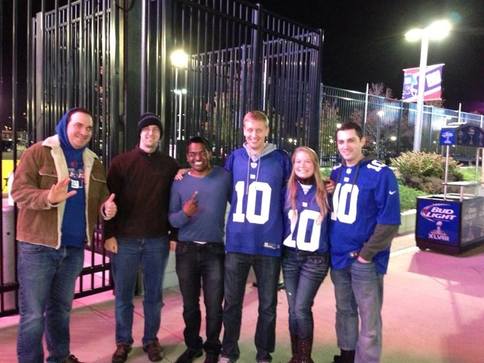
Regardless of the reasoning, though, the bottom line is that I quit watching the NFL entirely - with the notable exception of going to the Giants game with you the very next day - in 2013. And from there, I’ve tried to spread the word, perhaps aggressively so. :)
I’m not comfortable with our national pastime being a product that literally kills people. Half a dozen high schoolers die every year as a direct result of football injuries, so this is not just a professional problem. It speaks volumes about us as a society and a culture that football is so entrenched, and I want to help to drive positive change.
Chris: And I think I’ve been pretty open about my own declining interest in the NFL over the past 2-3 years, though not necessarily the sport of football.
But let me play devil’s advocate here: setting aside more obvious comparisons like Hockey, Boxing and UFC, there seems to be growing evidence of short and long term risks associated with playing many sports from the high school through professional levels. For example, brain injuries stemming from soccer or some (perhaps surprising) evidence of higher mortality rates among MLB players than among NFL players. Plus, while the absolute numbers may trail football, baseball has experienced more than their fair share of on-field deaths directly related to play.
So tossing it back to you, what is it specifically about football that differentiates it from other sports in your mind?
RJ: I think it’s the visceral and violent nature of the sport itself. I really started to become uncomfortable with it consciously after seeing this hit during a Ravens-Steelers playoff game back in 2009.
I remember feeling numb for the rest of the day. Even watching the clip now all these years later makes me feel light-headed. It looked like Willis McGahee was dead.
I don’t doubt the science behind soccer’s impact on the brain, and I concede that baseball has its share of freakish injuries. But football’s entire raison d'être is violence. You see it every single play. It’s not accidental or incidental.
Then you start looking at the list of the players with confirmed CTE upon their death. Junior Seau killing himself in 2012. Brett Favre saying he wouldn’t let a hypothetical son play football. Antwaan Randle-El and Neil Smith regretting playing football entirely.
Does any other sport have a track record like that?
And that is just the proven cases. We could speculate all day long as to whether the entire, sordid OJ Simpson saga was fueled by brain damage from his NFL career.
Chris: One of my favorite writers, Spencer Hall of Every Day Should Be Saturday, wrote a fantastic piece in September touching on the nature of football and his own discomfort with a sport that he writes about 365 days a year. He stated:
“Football is codified violence, where we continually as football people channel, legislate, and then commodify that violence.
We don’t just do that in terms of outcomes. We do that in form, regulating what is acceptable violence and what is unacceptable violence. When someone like Reggie Brown is tattooed and left flat on a field, it’s not the idea of violence that people condemn. It becomes about leading with the head, or going low, or hitting past the whistle, or some other violation of the rules we built around and under and over the basic angry core of the sport itself. It’s not that you made the mistake of climbing into a tiger’s cage; it is that you didn’t properly address him, serve his snacks in the correct order, and then failed to send him a thank you note.”
Later in the piece, he takes a broader view:
“The violence at the heart of football is the thing that will eventually kill it. It’s in the bones and marrow of the sport, and has been forever, and fatalism in the face of it or mitigating it by degrees of manner or ritual or rule is a dodge. The worst part isn’t even that it’s thrilling, even in measures we consider acceptable like doses of radiation.
The scariest part of thinking about the inherent violence of football — America’s most popular sport, even now— is that it’s just a sliver of something huge and more monstrous and inescapable. That being an accomplice is a fact of being American. That somewhere in a long history of violence, even the home I buy or the car I drive or the food I eat is a feeble payment against a long debt of crushing injustice, inequality, and ambient malice.”
It’s a damning review of the sport. Let’s start first with one of the claims above - do you think the sport of football will ultimately die? If so, how long is that window?
RJ: Fantastic take from Mr. Hall there - really beautifully written.
As for your question, will the sport die entirely? No way. Will it lose its hold as the clear #1 sport in America? Absolutely. And in our lifetimes.
I think Malcolm Gladwell’s take is probably on point. Fewer people will start playing, those that do will retire earlier, and football will lose a chunk of its talent over the next generation to other sports. At the same time, we will learn of more athletes suffering from brain damage and publicly commenting on how they regret playing football. The sport will adapt with equipment and rule changes that do little to stop the trend, as these changes will be seen by existing critics as mere bandages and by existing fans as the ongoing wussification of the sport.
Ultimately, the on-field product will suffer, interest in the sport will wane, and it’ll settle in as a fairly popular regional sport that no longer captures national imagination.
Sound plausible?
Chris: Plausible, yes. But I wonder what replaces it as the top sport. I agree with Spencer on the premise that there is a violent, animalistic nature of being American, especially of being an American male. We’ve seen it, for better or worse, at Trump rallies the past 18 months. I think it carries over to the liberal, educated populace of the coast as well: while physical violence is frowned upon, look at the nature of American business. How many people view things as a zero-sum game?
Football, more so than any other mainstream sport, presents itself as a distillation and cleaned-up representation of war, which makes it the most American of sports.
Is there a sport capable of filling that void? Do we even need that void filled?
RJ: I don’t think a sport will capture our imagination nationally in the way that football has, at least not for a few decades.
Basketball and soccer are the candidates everyone talks about. Basketball of course has the benefit of being popular with younger and more diverse audiences, while soccer is a natural outcome of ongoing globalization.
I could see both of those overtaking football in ethnically diverse areas and large cities, but not in Friday Night Lights territory. And baseball? Feels like a stretch given how much the sport struggles to maintain interest with younger audiences.
Do we need the void filled? Sigh. You could argue that our fragmentation in so many facets is a national identity problem. This past election and the aftermath show that clearly. Perhaps it doesn’t need to be a national sport that fills that void, but something needs to capture our collective attention and tap into our collective passion. Maybe it’s something like a trip to Mars?
Chris: Or, maybe the infamous Newt Gingrich moon colony?
I’d like to just probe a little deeper. In a lot of my conversations with people about my own discomfort with football and its long term effects, the response is pretty straightforward: well, they are choosing to play.
Do you have an issue with the continued existence of this (and other) sport if athletes are willing to participate?
RJ: I do. I know, I know, #nannystate
I’m least uncomfortable with this at the professional level - perhaps surprising given the #quittheNFL framing - because they are at least being paid. I’d be more comfortable if it were crystal clear to players the degree to which they are sacrificing the rest of their lives before they chose to participate. I’d also like to see a much larger retirement health fund that covers all players who have played in the NFL for any period of time. That wouldn’t be enough to bring me back to the sport, but it’d make me more comfortable with its existence.
At the college level, I already have real issues with the “education as payment” model, but it goes beyond that. College players come in as teenagers who are opting for a chance at glory, and I’d argue that, payment or no payment, the long term repercussions of the decision to participate are not going to be realistically and objectively considered at that point in their lives. It is ultimately exploitative in a sense even if the players get paid fair market value.
For anyone younger than that, you add to the compromised decision making process the real physical trauma that football can inflict on bodies that have not reached their full development. I’m with Dr. Bennet Omalu here - kids shouldn’t play full contact football at all.
Finally, while everyone makes and owns their decisions in lives, I think we have a responsibility to our fellow citizens to look out for each other. I would never want a family member or close friend of mine to play football for a living knowing what will happen to them down the line, so why should I be okay with a stranger doing it? I want to help discourage the decision to play football for others, even if they ultimately make the decision themselves.
Chris: I’ll put the college discussion aside for another time.
So let’s talk about life post-NFL. You “quit” in 2013, have you been able to completely separate? Or does the sport still find ways to creep into your life? I know this is an unfair question because I’ve mentioned American Hero and Future Hall of Famer “Touchdown” Trevor Siemian in like 50 conversations with you this year.
RJ: Early on, it was not an easy or clean separation. I was hate-checking box scores and hate-following games on Sundays, just without turning the TV on. And I still watched the first two Super Bowls after “quitting” with a “this is a pop culture event” loophole. (I did finally skip it last year, even though my old favorite team, the Denver Broncos, won.)
Over time, it has gotten easier. Getting Sundays back just as Damon entered my life was fortuitous timing. Now instead of watching TV for hundreds of hours a year, I can spend it with him and watch him grow up.
Honestly, it’s also brought a different framing to my weeks, where I’m not constantly obsessing about looking forward to Sundays. Now I look forward to more spontaneous and varied activities.
I do still check the standings occasionally, and thanks to “sports Twitter” I know some of the playoff teams. The Patriots are still good, right?
I feel like I’m in a good place now. I don’t miss watching or following the NFL. Honestly and truly. I’m surprised about that, given how much of my life I devoted as a fan. Ten-years-ago-Ronjan would never have believed this as a possible outcome.
The one thing I miss? The camaraderie of fantasy football. There’s really nothing like it. But that’s all I miss.
Chris: Pats-Giants Superbowl in February: would you watch?
RJ:

Chris: To wrap it up, is there any way you think your would get into football some point down the road? Rules changes? Other tweaks that could bring you back?
RJ: I don’t see a path towards it. My ultimate problem is with the sport’s violence and its ramifications. I can’t think of rule changes that solve that problem and maintain the core of what the sport is about.
I won’t say “never”. Again, 10-years-ago-Ronjan would be stunned by the concept of me skipping a Super Bowl that the Denver Broncos won, so perhaps the opposite is in play at some incredibly low probability.
Ultimately, though, I’ve moved on. #quittheNFL has worked well for me. :)