 FAKE RONJAN!!
Sling TV Review: The Perfect Product for a Different Me
After more than a year of debating, I finally bit the bullet and followed the trend of many of my close friends, cancelling my cable subscription in January 2014. I bought myself an antenna and prepared for the cord-cutting life. On my call to cut off service with Time Warner I was asked repeatedly why I wouldn’t want my cable package that “offers so much content,” with “over 200 channels of programming.” My answer was simple: I only watch 4-5 channels at all, a total that made the $60+ monthly fee for cable a losing proposition in my mind.
That math may not have been strictly true at the time. Cancelling cable meant losing ESPN (plus NBCSN, SNY and Big Ten Network) with no legal alternative to watch that content elsewhere. My desire to see how Northwestern basketball was growing under its first year head coach led to the occasional bar trip to catch a game. Things got worse as the Rangers streaked through the playoffs in May and June, with every playoff game becoming a reason to stroll down the block to the neighborhood sports bar. Easily blowing more than $30 on each bar tab begged the question: was cord cutting really worth it?
As summer rolled around the issue became less pressing. The Mets were in the middle of another sub-.500 year, making their absence from my nightly TV life almost unnoticeable. In place of baseball and a steady stream of Seinfeld and Family Guy re-runs on TBS, I dove wholeheartedly into the depths of my Netflix subscription. For the first time, I took advantage of Amazon’s Prime Video library – including the incredible addition of much of HBO’s TV library. I found myself talking more often with my friends about House of Cards, OITNB, The Americans, Bob’s Burgers, Sons of Anarchy and Game of Thrones (ok, for that one I hijacked a friend’s password) than about Matt Harvey’s injury or the Mets’ desperate need for a new shortstop.
And then, surprisingly, it continued into the fall. While I kept up my tradition of viewing all Northwestern football games at a Northwestern bar across town, on Saturday nights and bye weeks I didn't find myself searching for ways to catch the rest of the football slate on TV – my 12 hour football Saturdays of the past were suddenly over. Even with my antenna giving me CBS, FOX and NBC, NFL Sundays started to feel more like, well, Sundays.
By the end of the year I was acutely aware that my sports-watching habits had changed, but I was also sure that it was circumstances that had changed the habits… I couldn't have possibly changed myself. Subconsciously, I created a set of theories to explain this:
- My teams were bad: With the Mets headed towards their 8th straight year out of the playoffs, why would I want to watch them? Northwestern football falling out of the national picture with back to back 5-7 seasons meant that other CFB games around the country no longer impacted our season, and were less appealing to watch. The Giants and Knicks were down, too. For how long? Who knows.
- I didn't have the time: Getting a serious girlfriend meant that I had less time to myself, so of course I’d have less time to watch TV, including sports. In the time that I did have to myself, why not catch up on the TV shows I know my friends want to talk about?
- I still feel like I wanted it: There were a few moments where I reconsidered my decision to end cable. That has to mean I want to watch more TV, right?
I was convinced I still needed parts of cable in my life. In conversations about cord cutting, and in social media posts, I begged ESPN to take my money and just give me a standalone subscription for $15-20 a month. I wanted my Monday Night Football, my long fall Saturday football binges, the occasional late night baseball, football or basketball game that you stumble onto and get pulled into completely. The option to follow up after text from a friend saying “dude, quick…turn on ESPN. This game is crazy.”
So it was that I could barely contain my excitement upon hearing that DISH Network would be releasing Sling TV, an internet-only cable package of about 12 channels including ESPN, for just $20 a month. The package covered everything I missed about TV: ESPN and ESPN2, TBS/TNT for basketball, and CNN – the network I love to hate, but love to have when big news breaks. When DISH later announced the addition of AMC to their lineup, I couldn't imagine an offering more precisely suited to my needs. I signed up on the first day of public release, February 9th of this year.
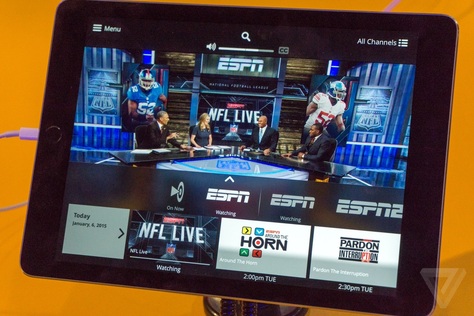
Sling TV worked exactly as I’d hoped, possibly even better. The picture was clear and crisp. The app stopped to buffer, or got pixelated, more rarely than the TV signal from my antenna ever had. With each channel’s lineup clearly displayed in the app, you could quickly look ahead to what was coming up over the next few hours, if you were planning on just having something on in the background. As far as I could tell, Sling TV had limited, if any, Video on Demand services. But not having that expectation going in meant that this aspect wasn't much of a downside for me. I’d just gotten almost everything I wanted from cable at just a third of the price.
That first night, February 9th, I got home and flipped on Sling TV. ESPN had Florida State taking on #4 Duke in men’s basketball, and the score was close early on. Perfect. Exactly the type of game I’d missed for the past year. But then a strange thing happened.
After no more than 5 minutes of watching the game, I suddenly got the desire to get back to catching up on The Americans, a wonderful FX show I’d been watching on Amazon Prime. Duke was taking a lead in the game, and without any rooting interests and the hope for the upset fading, I simply lost interest.
Over the next two weeks, on the nights when I even thought to turn on Sling TV, I found the same thing happening. Sometimes I’d briefly channel surf, only to end up deciding that Netflix and Amazon were what I was really in the mood for.
Despite my hopes, the fact is that my media viewing really has changed. A year+ out from my call to Time Warner, TV is no longer a standard “background noise.” Hours of leaving the TV on while multitasking are gone. To me, TV is now built on engagement: I've become used to actively seeking out the content, so when that content is on, I’m watching it.
And I’m constantly seeking out content. Beyond my Netflix and Amazon obsession, whenever my time allows, I catch up on The Daily Show, Colbert (now Wilmore), and whatever Last Week Tonight clips are up on YouTube. I may click onto videos through Facebook or links from a friend. Almost exclusively, I’m consuming this “clip” media on a phone or tablet. And If I’m watching media on my phone or tablet, I am completely tuned out to the media on the TV...in some cases, even annoyed by the competing sounds and images. So the background noise loses. And in a world where even the channels I want above all else will never have continuous engaging content in the way that the digital world will, live TV is ultimately not important most of the time.
Had Sling TV been available a year earlier, or had I waited to cut the cord, it’s possible that my behavior would never have transformed to the degree it has. But just three weeks into my Sling TV experiment I've come to realize that my dream hasn't been a product like Sling TV, the dream has been my demand for it.
-Chris
A Second Take by RJ
I liked Chris's article so much that I wanted to chime in as well. Much like him, I am a cable cord cutter (since June 2011) who has been reliant on Netflix (year-round), Amazon Video (year-round), and Hulu Plus (cancelled every summer) for "TV" viewing solutions.
I was so excited by the Sling TV announcement that I immediately purchased a Roku 3 (since my existing PlayStation 4 was not supported by the service) and signed up for early access. On February 1st of this year I installed Sling TV. Pardon the Interruption, SportsCenter, and Inside the NBA were all mine to watch again. It was glorious.
So why do I continually find myself watching on-demand content instead? It's one thing when I want to watch season 3 of House of Cards, but even content that I put on in the TV in the background while I'm doing something else is far more likely to be Netflix, Hulu, Amazon, or even YouTube than the live TV I just re-acquired.
I think Chris is right. Cable cord cutters have trained themselves for more purposeful TV viewing. I control the schedule. No one else.
That said, I have a very clear counterargument to all of this: I need ESPN and TNT to watch the NBA playoffs. For that very specific situation, Sling TV is well worth the investment. (I also think it's notable that Chris's version of the NBA playoffs is the NCAA Football playoffs, only viewable on ESPN.)
The question of the day: after the NBA season ends, will I cancel my subscription?
-rj