 FAKE RONJAN!!
NBA Finals: does 2-3-2 format have an impact?
A few weeks ago, we took a look at the NBA Conference Finals to see whether there were any interesting trends we could pick up game-by-game that weren't well-known. However, that was really an offshoot of a bigger question: does the NBA Finals 2-3-2 format have an impact on the actual results of the series?
There are two theories here.
Theory One: In giving the lower seeded team three straight home games in the middle, it's giving them a huge disadvantage. Basically, it puts the pressure on them to win two games on the road, because it is very difficult to beat a quality team three times in a row, even at home.
Support: Until 2004, no team had ever won at home in games 3, 4, and 5.
Theory Two: In giving the lower seeded team three straight home games in the middle, it's giving them a huge advantage. Basically, if they are able to steal one of the first two games, they can then take the series without having to leave home.
Support: This has been done three times in the past 9 seasons: 2004 Pistons over the Lakers, the 2006 Heat over the Mavs, and the 2012 Heat over the Thunder.
Let's dive into some quick numbers! All figures are from the 1985-2012 seasons, as 1985 was the year that the NBA Finals switched from a 2-2-1-1-1 format to the 2-3-2 format.
Average Series Length
Conference Finals: 5.7
NBA Finals: 5.6
This does not appear to significantly affect the length of the series. However, there is a more interesting story here:
16% of Conference Finals end in sweeps, and 23% go to game 7
14% of NBA Finals end in sweeps, and 14% go to game 7
So in the end, it looks like the 2-3-2 format in the NBA Finals trades out 4-game-sweeps and 7-game-series in exchange for middle-ground series. It's tough to generate a causal link, of course, but we can build on this by bringing back three builds from the previous post:
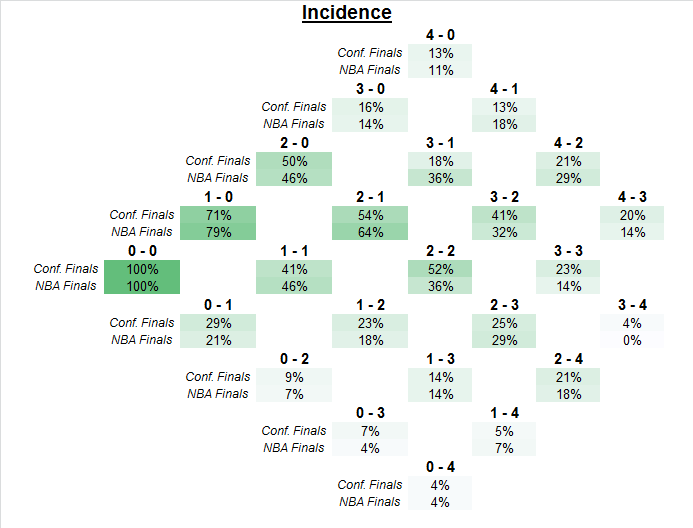
This diagram lays out the percentage of all series that have the given score. So the NBA Finals is more likely to be 1-0, 1-1, 2-1, and 3-1 at each respective stage than the Conference Finals. The 3-1 split, in particular, is fascinating. Perhaps it suggests that if the lower seed is down, 2-1, they don't have as much of a sense of urgency in game 4 because they know that game 5 is also on their home court?
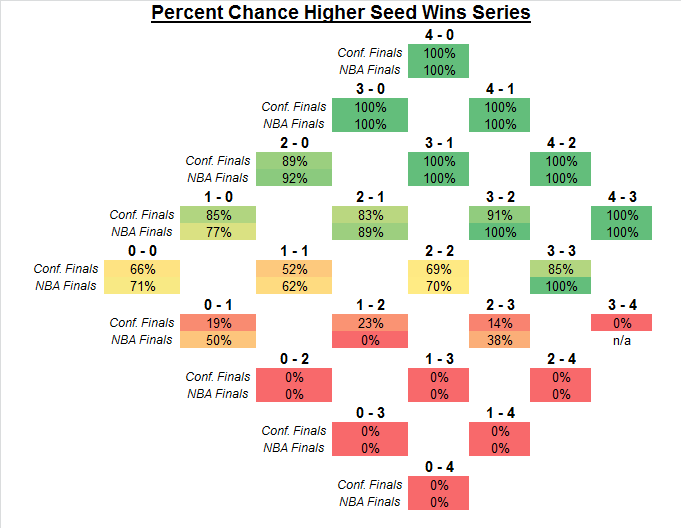
This time, we're looking at the odds that the higher seed wins the entire series given a particular score. When the road team wins game 1, like the Spurs did last night, it's much less of a boon to their chances than it is in the 2-2-1-1-1 format. Clearly again speaking to the rarity of sweeping games 3, 4, and 5.
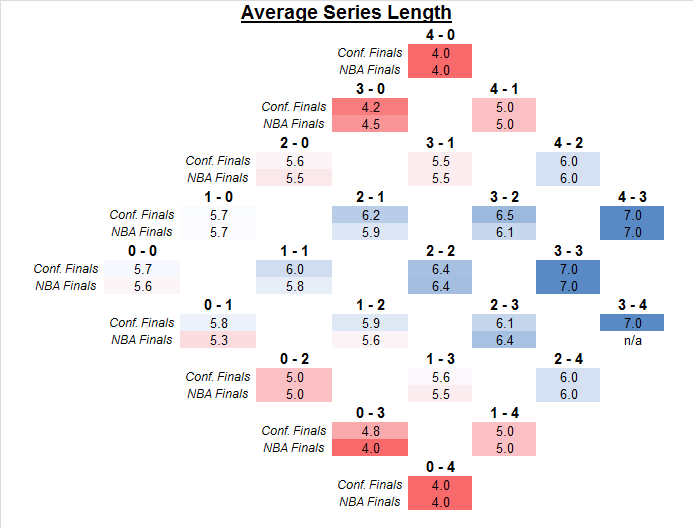
This one shows the average length of the series given a score, and I don't think anything interesting is going on here.
So, do we have a takeaway? Maybe. It does seem that the 2-3-2 format is a disadvantage to the lower seed, not an advantage. And while it may slightly decrease the chances of seeing a series sweep (which the NBA wants to dial down), it also decreases the chances of seeing a series go to 7 games (which the NBA wants to dial up).
The NBA should switch back.
-rj