 FAKE RONJAN!!
Stupid, Stupid Idea: ditching the owner model
I had originally planned to post a Box Score Monday today detailing how me and my friends enjoyed the late-90s Knicks-Heat rivalry in suburban Cincinnati. Then Donald Sterling opened his mouth. Reset.
I don't have a unique take here -- there's only one defensible angle on this story and it's been covered particularly well. I particularly appreciated ESPN NBA Countdown's willingness to get straight to the point.
My question in the light of this is actually quite broad: why do we have owners in the first place?
For niche & new sports leagues, it totally makes sense. Someone needs to front the cash to get the league infrastructure set up, and they'll rightfully expect to be rewarded on the back end. I get it. That's basic venture capital & entrepreneurship.
But the NFL? The NBA? Major League Baseball? These are different animals. They're established businesses, they're cash cows, and they're inextricably embedded into our culture. Yes, these leagues are big business, but they're also (corny alert) a part of who we are.
Given this -- do we really need owners who run the teams for private profits? Or are we better served with a community-ownership model like the Green Bay Packers?
The New Yorker's Dave Zirin and ESPN's Patrick Hruby each made compelling cases for this in 2011 as the Packers were making a Super Bowl run. There are several key points, but here are some of the notable ones:
- The Packers have an inherent stability that no other franchise has. They are never leaving town, and they are not subject to the whims or vices of any one person.
- The team runs as a non-profit -- any excess revenue is re-invested into the team. As such, ticket and concession prices are more affordable and the team's books are open.
- The team exists for the community, and the members of the community literally have a stake in it. This creates a sense of connection to the team that no other fanbase can have.
- The team's by-laws ensure that no one person can ever gain control to undo this.
These are meaningful benefits, and I'm proud to be a single-share owner of the Green Bay Packers (despite having ended my support of the NFL, forever).
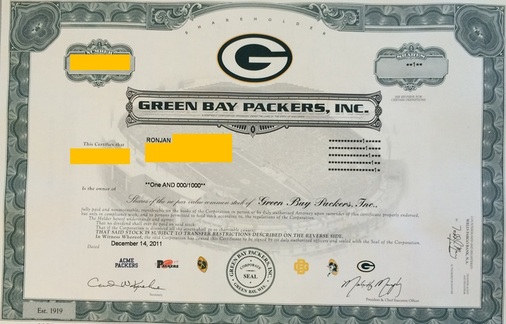
Beyond team stability, league stability is a factor, too.
Notably, every sports league has had some kind of major labor trouble in the past 20 years -- with this fall being both the 20th anniversary of baseball's canceled World Series and the 10th anniversary of hockey's canceled season. Would this ever happen in a world where communities owned teams?
During the recent NBA lockout, there was some talk of a related idea -- player ownership of franchises. Grantland's Bill Simmons and Jay Caspian Kang ran a thought-exercise piece on how this could work, semi-tongue-in-cheek. While the endgame of such an arrangement wouldn't necessarily benefit fans, I thought the opening premise was particularly meaningful:
George Will says that baseball is the one instance where a worker-driven system makes sense. To paraphrase, he says that in the history of the game not one person has bought a ticket or turned on a television to watch an owner. As such, because the products are the players, the players should control the majority of the wealth.
And that's coming from George Will, certainly no friend to the little guy in labor situations!
So what's the counterargument? Is it just as simple as power and control?
Perhaps billionaire owners that operate for-profit franchises are likely to be more like-minded than several groups of elected board members. That means that leagues can be more nimble and can focus on initiatives that generate more revenue rather than less profitable initiatives that are best for the communities and the fans themselves.
The ownership model has a history of working very well. Particularly so for the 30-some billionaires who get to control hugely profitable, multi-billion-dollar operations. But I wonder if some at the NBA are wondering today whether it's all worth it. The next few days are going to be fascinating.
-rj