 FAKE RONJAN!!
Are NBA Superstars Paid Enough? Take #1
Is the NBA max salary unfair? Are the top players in the NBA being stripped of earning power because of an arbitrary salary cap ceiling on the amount they can earn?
I had long thought that the answer to both of the questions above was a clear "yes". If LeBron James were out on the open market, he'd surely bring in $50 million or more per year, as opposed to the $20.6 million he'll bring in this season.
Zach Lowe wrote a great piece on Grantland last year about the ramifications of removing the salary ceiling, which is another question in itself. I wanted to focus on the value side first, though: if we paid everyone in the league what they were worth, would the best players get paid more than they do today?
There are many ways to approach this question, so I started simple. I needed to find the following two data sources in order to get started:
- A reliable source of player contracts
- A reliable source of player value
The first piece is easy. ESPN makes this data readily available. Done deal!
Now for the player value piece. I settled on win shares as a starting point. Basketball-reference.com has a very detailed breakdown about this metric, but here's the basic idea:
Win shares evaluate a player's production as well as how a team performs, both on offense and on defense, when a given player is on and off the court. The formula then allocates wins to individual players based on their contributions to the team. The end result is a metric that ranks players on a relative basis by how many wins they contributed to for their team. The 2013-2014 rankings may not be perfect, but they appear to pass the sniff test.
Next, we have to figure out how to compare the two. This is where it gets tricky. The NBA has many overvalued and undervalued players based on cheap rookie contracts, bad max deals, injuries, and many other factors.
On one hand, we have players like Amar'e Stoudemire, who netted a $21.7 million salary while producing just 3.8 win shares last season. On the other hand, Paul George contributed 10.8 win shares on a mere $3.3 million salary. We can find outliers on both sides that prove an agenda in either direction.
I decided to take the extremes out of the picture. Forget about lining up players in terms of salary and payroll. Instead, why don't we rank-order salary from #1 through #338, then separately rank-order win shares from #1 through #338, and then see what we get?
The idea here is that the distribution of salary and win shares may not substantially change, year-to-year, since contracts carry-over and win shares have to add up to league total wins. From here, if we assume that the #1 paid player generated the most win shares, the #2 paid players generated the second most, and so on, we can look at the two curves and see when salary is higher than win shares and vice versa.
Below is a graph of what that looks like. The results were very surprising to me.
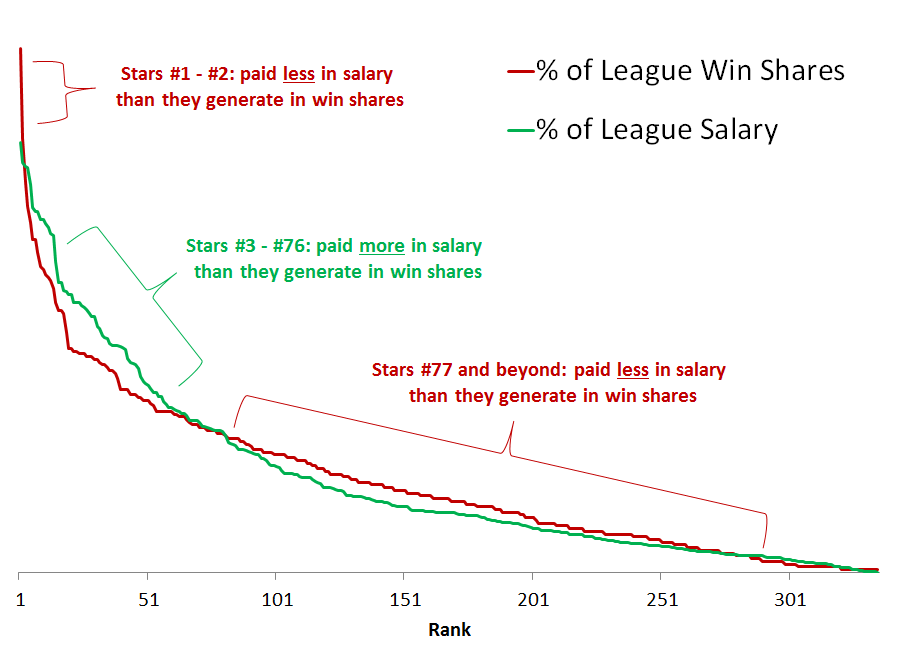
When the red line is above the green line, that means that the player is generating more wins for his team on a relative basis than he is being paid in salary. When the green line is above the red line, it's the opposite -- the player is being paid more.
I had expected the red line to be above the green line for the top 20 or so players, with the idea being that payrolls were capped and truly exceptional performances would not be fairly valued -- but the opposite appears to actually be true!
This analysis shows that, on the face, the very top, uber-duper-superstars like LeBron and Durant should be paid a bit more, but the next tier down is actually overpaid. Is it possible that the max salary is pulling salaries up for undeserving players, taking away potential dollars from mid-level contributors? Had we focused on the max salary in the wrong direction all along?
There are of course several other possibilities:
- Win shares may be a flawed metric for this analysis
- The distribution approach is flawed and overlooks real discrepancies in player pay
- Focusing on just regular season production misses out on true, championship-level value
- Focusing on just on-court production misses the mark for how valuable top players are
Any thoughts? I'd like to revisit this and see if other approaches can back up this conclusion.
-rj